Repairing our Pavements
We want a street that is safe to walk on, and pleasant to gaze upon
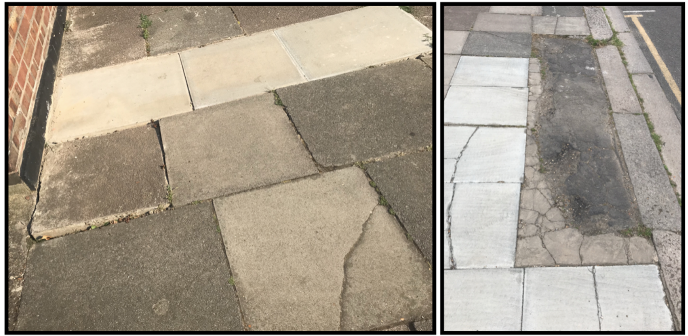
Many MPR residents are upset about the condition of our pavements – the uneven slabs, ugly blotches of asphalt, places where unruly roots have caused hillocks around tree roots. Older people feel they risk falling over and breaking bones. More generally, the road gives off a feeling of degradation that does nothing to deter criminality.
However, the condition of the pavements is not sufficiently poor – in comparison to other roads in Brent – to create any likelihood of the Council doing anything other than put down more splodges of asphalt. This means that the only way we are going to get anything done is by taking on the responsibility ourselves, along the way persuading the Council to let us collaborate with them in the fulfilment of ‘their’ statutory responsibility).
The total footpath area is around 2,585 square metres. Of this, 1,445 is made up of standard 750 x 600 slabs. These comprise 74 areas (between driveways) of between 9.45 and 26 square metres. The 95 driveways have an average size of 12 square metres – so covering a total of 1,140 square metres.
Of the 96 driveways, one is small-block paving; two are just tarmac; 20 are just paving; 13 are just concrete; 35 are a mix of paving and concrete; 18 are paving and tarmac; 6 are paving, tarmac and concrete; one is tarmac and concrete. A lot of these drives are badly damaged. All contributing to the total mess we have to walk upon.
A very rough estimate of the total cost of doing the whole street as a single job would be £400,000.
Here is how we might approach things:
- Patches of road are regularly re-paved by utility companies (gas, water, electricity, cable) digging up bits of the road. We might be able to get quite a long way simply by liaising with the utility companies, motivating them to do the best possible job in the public interest – we would be supervising their work on ‘our’ street. By purchasing a stock of slabs, we could ensure that they always use the same ones when replacing those that have been damaged (which they do ‘for free’).
- We could identify patches of the road that are particularly unsafe or unappealing and raise the money ourselves to get them done.
- Along the way we might find that the Council did have small pots of money left over from the major work in other roads that they could allocate to our project.
- Those who have the financial resources could take on the cost of upgrading of their drive, and could do this to a specification we have all agreed upon. It would make their personal ‘space’ look nicer while making a contribution to their community.
- We could make fundraising applications for Islands of Calm (replacing several parking bays with fenced areas for additional planting), presenting them as an innovative way of creating safer, friendlier and greener communities.
- And we can ensure all new trees are planted – and then cared for – in ways that allow roots to go downwards and sideways rather than tearing up pavement. For the 16 trees planted in the spring of 2026, we persuaded the Council to follow what we understand to be best practice and excavate a hole that is three times wider than it is deep, which is then filled with high-quality soil and compost.
Join in the conversation:
help us develop a strategy
help us develop a strategy